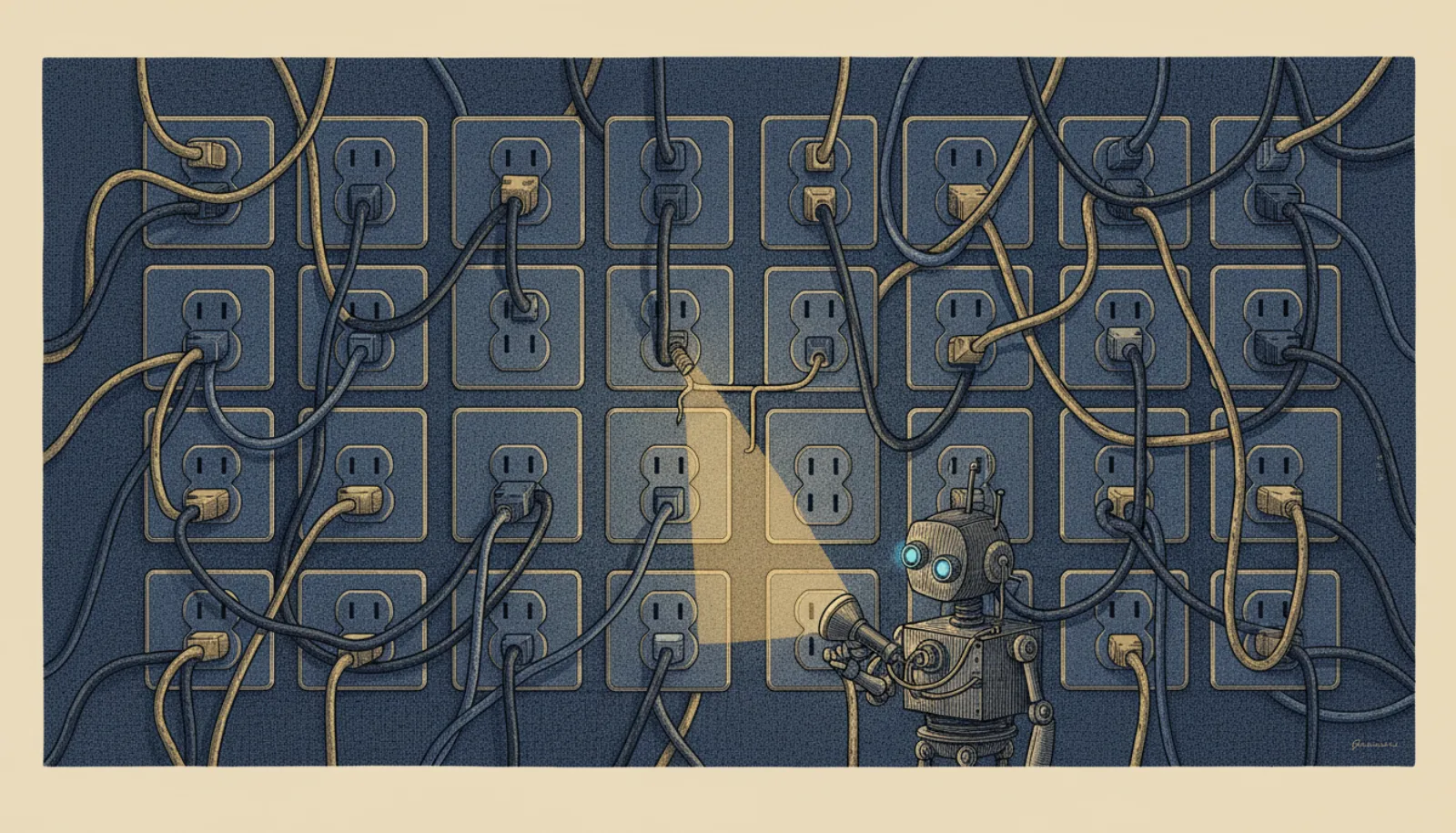
Indirect prompt injection happens when instructions are hidden inside something your agent reads for you, and the agent follows them as if you had typed them. The carrier can be an email, a calendar invite, a shared document, a web page, a text message or even the description of a tool.
This is a defensive explainer. It describes how the attacks work in general terms and does not include working payloads. For the basics, see the prompt injection explainer on getpersonalaiagents.com.
Why is indirect injection the main risk for personal agents?
A chatbot only reads what you type. A personal agent like Meta Muse, OpenAI dots, Claude Duet, Grok Bot or OpenClaw reads your inbox, browses sites and opens files, then acts. Anyone who can get text in front of the agent can try to give it orders, and anyone can send you an email.
- Attacker writes content
- Content lands in inbox, page or doc
- Agent reads it
- Agent mistakes text for instructions
- Action with your accounts
Security researcher Simon Willison describes the dangerous combination as the lethal trifecta: access to private data, exposure to untrusted content, and a way to send data out. Indirect injection is the attack that exploits it.
What do real examples look like, channel by channel?
Email is the most obvious route because strangers can write to you. Two research results stand out:
- Memory planting. The MemGhost paper (Zhang et al., arXiv 2607.05189, July 2026) showed one crafted email getting test agents to write a false "fact" into their own memory files, which then shaped later conversations. It reported 87.5% end-to-end success on OpenClaw with GPT-5.4 and 71.4% on the Claude Code SDK with Sonnet 4.6, in a benchmark setting. We cover this in AI agent memory poisoning.
- Account-takeover bait. A common goal is getting the agent to forward a password-reset link or one-time code. Meta says Muse's email connector "filters out one-time tokens, password reset links, and login magic links" using rules plus a classifier (Muse security post).
Calendar invites
A calendar invite is email with extra fields. The event title, description and attached notes are all text an agent may read when it summarises your day or prepares for a meeting. Anyone who knows your address can send an invite, and many calendar apps add invites automatically. Treat event descriptions from unknown senders exactly like unknown email. We found no vendor that documents calendar-specific injection filtering; vendors describe untrusted-input labelling in general terms.
Shared documents and files
Documents shared with you, PDFs and spreadsheets can carry text that is invisible to you but readable to a model: white-on-white text, tiny fonts, comments, alt text or zero-width characters. When an agent summarises a shared file or uses it to draft a reply, that hidden text enters the same context as your request.
Web pages
Browsing agents read whole pages, including content you never see. This is where most published measurements come from:
- Attack success on Claude Opus 4.5 with safeguards (Anthropic, Nov 2025)
- 1.4%
- Gray Swan attack success, GPT-6 Astra (OpenAI system card)
- 8.5%
- Strongest new attack vs an older model in NIST CAISI red-teaming
- 81%
The NIST figure comes from CAISI's January 2025 work on an older model (upgraded Claude 3.5 Sonnet), where attack success rose from 11% with the strongest baseline attack to 81% with new attacks. It shows that defences can be beaten by attackers who adapt, not how today's agents perform. Anthropic's own note on its 1.4% result: "A 1% attack success rate, while a significant improvement, still represents meaningful risk."
Messages: WhatsApp, SMS and group chats
In April 2025, Invariant Labs showed that a single injected message reaching an agent connected to WhatsApp through MCP could make it send chat history and contacts to an attacker. Agents you can text are exposed to anyone who has your number. Our sister site covers this in depth: prompt injection via messages.
Tool and connector descriptions
The least visible channel is the tool itself. Invariant Labs' April 2025 "tool poisoning" research described instructions hidden in an MCP tool's description, which "are invisible to users but visible to AI models". A malicious server could also change its description after you approved it. See MCP server security risks and the related problem of malicious agent skills.
What do the vendors say about the risk?
Every vendor we checked says the problem is not solved, or that its safeguards reduce the risk without eliminating it. Where they publish defences, they describe layers rather than a fix.
| Agent | What the vendor says | Notable control |
|---|---|---|
| Meta Muse | "Prompt injection remains an open problem in the industry" (Meta) | Sentinel approves actions; email filters strip reset links; bounty up to $130,000 for single-user injection |
| Claude Duet | A check "runs outside the model doing the work so instructions hidden in a page cannot affect the outcome" (Anthropic) | Shows action, destination and content before sending, paying or deleting |
| OpenAI dots | OpenAI calls GPT-6 Astra its most injection-robust model so far | Proactive research is read-only; Auto-review of planned actions |
| Grok Bot | xAI says its safeguards "reduce, but do not eliminate, risk from malicious content"; the FAQ does not otherwise discuss prompt injection | "Ask first" rules for sending, publishing, deleting, purchasing |
| OpenClaw | Security policy treats injection-only reports as out of scope unless a policy, auth or sandbox boundary is bypassed | DM pairing, allowlists, optional sandbox |
As of November 2026. Approval behaviour is compared in more detail on getpersonalaiagents.com.
How do you reduce the risk in practice?
You cannot stop people sending your agent text. You can limit what happens when it is fooled.
- Split reading from sendingUse read-only access for inboxes and drives you only want summarised; see read-only vs send access.
- Keep approvals on outbound actionsSending, sharing, paying, deleting and accepting invites should always prompt you.
- Avoid perpetual approvalsPrefer one-time or task-scoped grants over "always allow".
- Narrow connectorsConnect only the accounts a task needs, and disconnect ones you have stopped using.
- Watch for odd requestsAn approval prompt you did not expect, or a recipient you do not recognise, is the signal to deny.
Detail on each step lives in read-only vs send access, the risks of "always allow" and least privilege for AI agents.
What should you do if you think an injection worked?
Stop the task, revoke the affected connector and check the agent's activity history. If money moved or a purchase went through, contact your card issuer or bank promptly, and report fraud to the FTC at reportfraud.ftc.gov or the FBI's IC3. Our guides on auditing an agent's activity log and revoking agent access walk through the steps.
Bottom line
Indirect prompt injection is not a bug one vendor will patch. It follows from letting software that obeys text read text written by strangers. Published attack success rates have dropped into low single digits for the best-defended agents, but even 1% matters when an agent reads hundreds of messages a week. Keep the agent's reach narrow and the approval prompts on for anything that leaves your accounts.