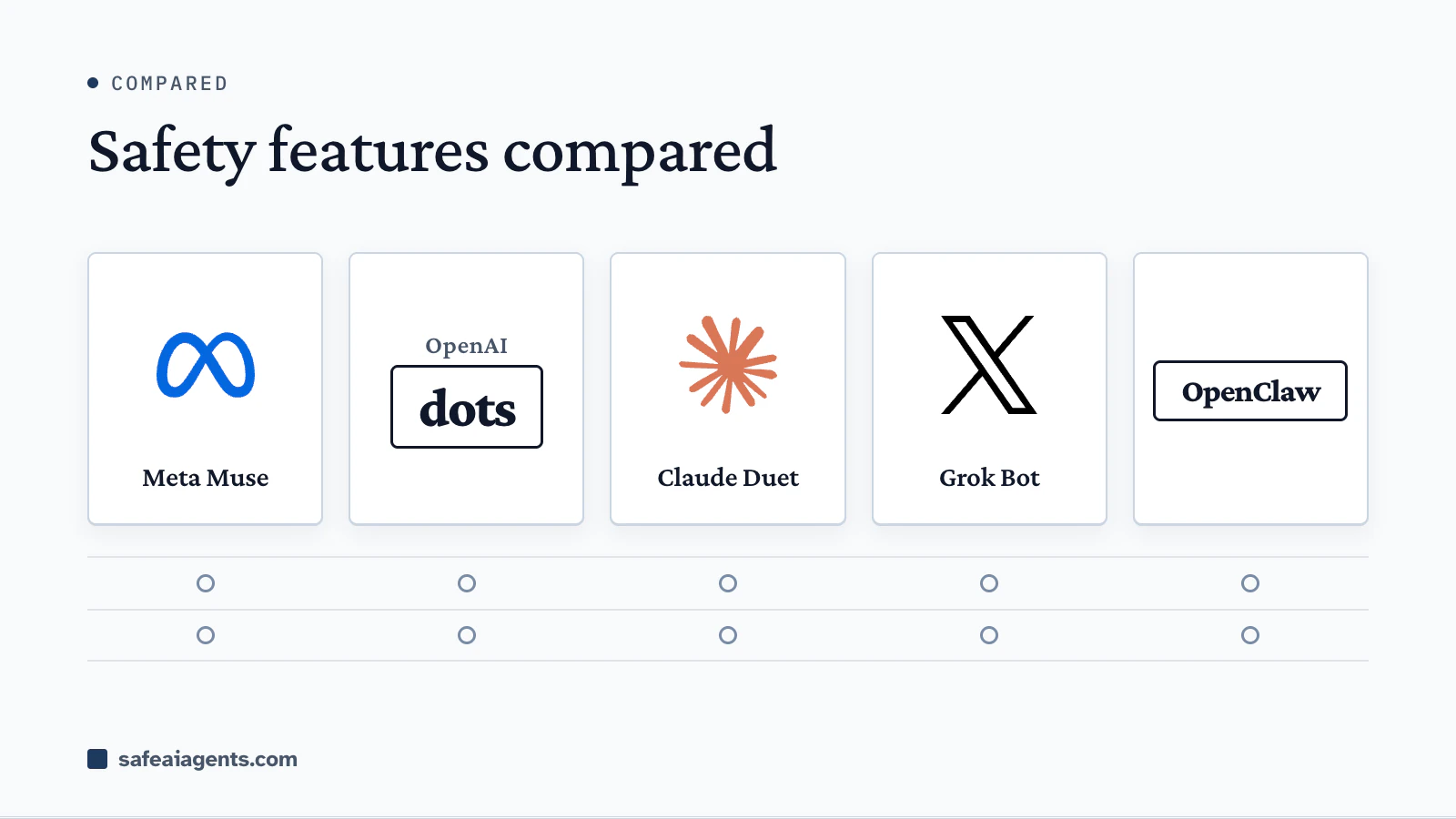
There is no single safest personal AI agent. Each vendor has made different trade-offs, and each publishes a different amount of detail. Based on the vendors' own documentation as of November 2026, Claude Duet sets the strictest hard limits on money, Meta Muse has the most granular permission system and the largest bug bounty, OpenAI dots publishes a measured prompt-injection rate, and Grok Bot documents a clear takeover flow for passwords and payments.
The comparison at a glance
| Feature (as of November 2026) | Meta Muse | OpenAI dots | Claude Duet | Grok Bot | OpenClaw (self-hosted) |
|---|---|---|---|---|---|
| Model sees passwords? | No, surrogate tokens | Password changes handed to you | No, per Anthropic | No, Vault or Secure Form | Whatever you configure |
| Permission authority | Separate Sentinel agent | Auto-review plus Custom Rules (4 modes) | Classifier outside the model | "Ask first" rules plus Auto Review | Exec approvals, DM pairing |
| Purchases | Every purchase needs approval | Saved-card purchases need approval | Always asks before paying | Takeover flow, you pay | Whatever you configure |
| Money transfers | Not separately documented | Always handed back to you | Blocked even with approval | Takeover flow | Whatever you configure |
| Payment instrument | Single-use Link cards | Saved card | One-time Link card, one merchant and amount | You enter it | Your choice |
| Isolation | Confidential VM not yet generally available | Not detailed publicly | Not detailed publicly | One cloud microVM per user, shared by all your Bots | Docker sandbox, off by default |
| Bug bounty | Up to $300,000 | Not dots-specific in docs we reviewed | HackerOne | Not mentioned in FAQ | No paid bounty |
| Minimum age | 18+ | Not confirmed for dots | 18+ | Not stated in FAQ | None (self-hosted) |
Google's Gemini Spark is 18+ and asks before purchasing or sending email, but Google hasn't documented spending-confirmation rules. Apple hasn't documented how Siri AI approves actions at all.
How do they keep your credentials away from the model?
Credential isolation matters because a model that never holds a password can't leak it, even if a prompt injection succeeds.
- Meta Muse: the agent sees only surrogate tokens, and the email connector filters out one-time codes and password-reset links, according to Meta's security post.
- Claude Duet: Anthropic states "Claude Duet never sees your passwords, browser cookies, sign-in tokens, or other credentials" in its safety article.
- Grok Bot: sign-in goes through Vault, a password manager, or a Secure Form; passwords, 2FA and payments go through a takeover flow where you control the screen (xAI FAQ).
- OpenAI dots: password changes and money transfers are always handed back to you, whatever your Custom Rules say, according to OpenAI's published rules as reported by eesel.
Our explainer on whether an agent can see your passwords goes deeper.
Who decides what the agent is allowed to do?
- Agent proposes action
- Separate checker (Sentinel, classifier, auto-review)
- Allow, deny or ask you
- Action runs
The strongest designs put the permission decision outside the model that reads untrusted content. That matters because the UK NCSC argues prompt injection "may never be totally mitigated" and recommends "deterministic (non-LLM) safeguards that constrain the actions of the system".
- Muse uses Sentinel, a separate agent that Meta describes as the only permission authority: "Muse proposes actions, but only Sentinel can grant permission." Approvals can be one-time, session, task, time-bounded or perpetual. See Muse safety settings.
- Duet runs an action check outside the model, based on Claude Code's auto-mode classifier, with a separate classifier for sensitive information. See Duet approval settings.
- dots has auto-review of planned actions and Custom Rules with four modes. See dots Custom Rules setup.
- Grok Bot asks each time before running desktop commands by default, offers "Ask first" rules, and expires approvals for unattended tasks after about 30 minutes. xAI presents Auto Review as a complement to least privilege, not a replacement. See Grok Bot computer access settings.
- OpenClaw has exec approvals, DM pairing and an
openclaw security auditcommand. See OpenClaw sandbox and exec approvals.
What will they refuse to do even if you approve?
Hard limits are the clearest safety signal, because they don't depend on you reading an approval carefully.
Pros
- Duet: no trading securities, no moving money between accounts, no accessing someone else's account
- dots: password changes and money transfers always handed back to you
- Muse: every purchase needs approval
- Google Home MCP: agents cannot unlock doors or disarm alarms
Cons
- Grok Bot: separate Bots share one computer and are not a security boundary
- OpenClaw: sandbox off by default; shared sessions are not a security boundary
What have they published about prompt injection?
The numbers below come from different tests and models, so they can't be compared directly. They show that each vendor measures the problem and that none claims to have solved it.
- Anthropic: Opus 4.5 browser-use attack success with safeguards (Nov 2025)
- 1.4%
- OpenAI: Gray Swan attack success, GPT-6 Astra system card
- 8.5%
- Meta: max bounty for a single-user prompt injection
- $130k
- Anthropic reported 1.4% attack success for Opus 4.5 with safeguards in browser use (8.0% without), and wrote that "prompt injection is far from a solved problem" (research post).
- OpenAI's system card for GPT-6 Astra, the model dots launched on, reports 8.5% attack success on Gray Swan, against 27.0% for GPT-5.6 Sol (system card).
- Meta has acknowledged prompt injection is not fully solved and pays up to $130,000 for a single-user prompt injection.
- xAI says Grok Bot's safeguards "reduce, but do not eliminate, risk from malicious content", and that Auto Review should complement least privilege rather than replace it. The FAQ does not otherwise discuss prompt injection.
- OpenClaw's security policy treats "prompt-injection-only attacks (without a policy/auth/sandbox boundary bypass)" as out of scope.
For background, read our indirect prompt injection examples or the prompt injection explainer on Get Personal AI Agents.
Where each one is weaker
- Muse: Meta's architecture doesn't stop Meta itself from accessing your data, training is on by default, the Confidential VM isn't generally available, and Meta hasn't published a retention period or full deletion steps (you can tell Muse to "forget" specific things). A zero-day was reported and hot-fixed in September 2026.
- dots: you can't view or edit individual memories, disconnecting an app doesn't remove what dots learned, and no retention period is published.
- Duet: still a research preview; data is kept until you delete it or reset.
- Grok Bot: one shared computer for all your Bots; deleting a single Bot is a soft delete.
- OpenClaw: scans have found "tens of thousands, and by some scans more than 135,000" exposed instances, and 341 malicious skills turned up in one early audit. Read is self-hosting safe?.
Bottom line: which should you pick?
If your main worry is money, Duet's hard limits are the strictest published. If you want fine control over how long each permission lasts, Muse's approval scopes are the most granular. If you want measured prompt-injection data, OpenAI and Anthropic both publish it. If you want full control and can maintain a server, OpenClaw can be locked down, but nothing is locked by default. Whichever you choose, the safety checklist applies.